Using the ADDIE Model to Build a Better Podcast
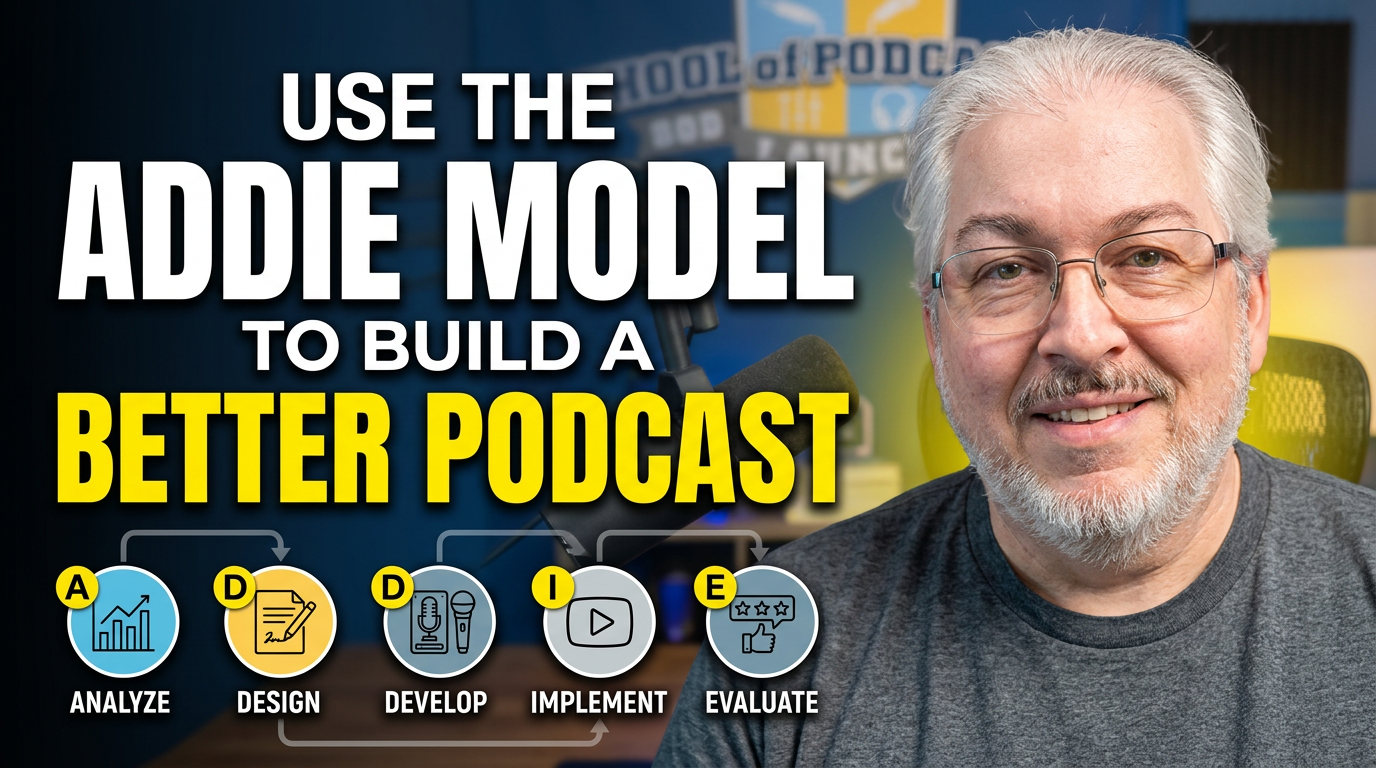
While cleaning out my basement before a waterproofing project, I came across some old college books from when I earned my Bachelor’s Degree in Education with a specialization in technical education. As I flipped through them, I found material on the ADDIE model: Analyze, Design, Develop, Implement, and Evaluate.
I’ve been using versions of this framework for decades while teaching everything from fax machines and email to Microsoft Office, time management, customer service, and podcasting. As soon as I saw it again, I thought, this would absolutely work for podcasters.
And the more I thought about it, the more it made sense.
If you already have a podcast, the ADDIE model can help you make better episodes, create a more consistent process, and stop guessing about what your audience wants. If you’re just starting a podcast, it gives you a simple framework so you can build your show with purpose from day one.
Podcasters are usually creative people first, and that’s a good thing. But creativity without structure can lead to rushed episodes, inconsistent publishing, and a whole lot of time spent making content that doesn’t really connect. The ADDIE model gives you a repeatable way to plan, create, publish, and improve your show without sucking the life out of the creative process.
Let’s walk through how it works and why it’s such a useful podcast planning framework.
How Podcasters Can Use the ADDIE Model
At its core, the ADDIE model is about being intentional. Instead of throwing content into the world and hoping it lands, you work through a process that helps you understand your audience, shape your content, and improve over time.
That’s why the ADDIE model works so well for both current podcasters and people looking to start a podcast. Whether you’re trying to grow an existing show or avoid beginner mistakes, this framework can help you make smarter choices every step of the way.
Analyze: Know Your Audience
The first step is to get clear on who your podcast is for and what it is trying to accomplish. I often talk about this as “knowing your audience.” Before you worry about gear, intros, or downloads, ask yourself a few simple questions.
Who is this show for?
What problem does it solve?
What makes it different from the other podcasts your audience could be listening to?
If you already have a show, this is also the stage where you look at listener feedback, download trends, retention data, and the kinds of episodes that seem to get the best response.
For new podcasters, this step can save you from creating a show that is too broad, too vague, or trying to serve everyone at once. For existing podcasters, it is a chance to make sure your content still lines up with what your audience actually wants.
You might even create a simple listener profile. What are they struggling with? What are they hoping to learn, feel, or achieve when they press play? The better you understand your audience, the easier it becomes to create episodes that resonate.
Design: Know Your Why and Your Who
Once you know your audience, the next step is to design the structure of your show. This is what I call “knowing your why and your who.” This is where you stop winging it and start making intentional decisions about how your podcast will work.
Think about your format, your episode length, your tone, your publishing schedule, and the overall experience you want to create. Will your show be solo, co-hosted, or interview-based? Will episodes be tightly structured or more conversational? Are you publishing weekly, twice a month, or whenever the moon and your calendar align?
This is also a good time to think about your episode flow. What happens first? How do you hook the listener? Where does your call to action go? How do you close the episode in a way that feels natural? These choices matter because they shape the listener experience and make your show feel more consistent.
For podcasters who are just starting out, design gives you direction. For experienced podcasters, it can help you tighten things up and make your workflow easier to repeat.
Develop: Create the Content and Assets
Now it’s time to build the actual content. This is the part where you record episodes, write intros and outros, create show notes, prepare interview questions, edit the audio, and build any promotional assets you want to use after the episode goes live.
This is also where you want to think about how you want your audience to feel. Do you want them to feel informed, encouraged, challenged, entertained, or inspired? That emotional outcome matters just as much as the information you share.
A strong development process helps reduce last-minute stress. Instead of scrambling every time you publish, you begin to create templates and repeatable systems. Maybe you develop a standard episode outline. Maybe you create a checklist for recording day. Maybe you build a reusable process for writing show notes and social posts.
That kind of consistency does not make your podcast boring. It makes your podcast sustainable. It also saves you time. More planning leads to less editing.
Implement: Publish the Episode
This is the point where all the preparation turns into action. You publish the episode, distribute it to the major podcast platforms, and promote it in the places where your audience already spends time. This is what I call “publishing the episode.” We have aimed, and now we have fired.
If you have done the work in the first three stages, your episode should be much more likely to land with the right listener. That doesn’t mean every episode will be perfect, but it does mean you are making intentional choices instead of tossing content into the world and crossing your fingers.
Implementation is also where you can test things. Try different titles. Try different release days. Try different promotional messages in your email newsletter or on social media. Small tests can teach you a lot over time. The best schedule is the one that works for you.
So many podcasters try to squeeze their life into their podcast. That is backwards, record a few episodes and time the whole process. Then choose a schedule that will enable you to squeeze your podcast into your life (as your life is more important).
A lot of podcasters publish the episode, wipe their hands, and move on. That is not a strategy. That is hope with a microphone.
Evaluate: Improve What Comes Next
This is the step too many podcasters skip, and in my opinion, it is the most important one.
If you never evaluate your show, you end up doing the same thing over and over without getting much better. You might keep using the same format, the same intro, the same episode length, or the same promotion strategy without ever asking whether it is actually working.
That is why podcast evaluation matters so much. This is where growth happens.
Yes, look at downloads. But don’t stop there. Look at completion rates in Apple Podcasts and Spotify to see how far people are listening. Pay attention to comments, replies, reviews, and emails from listeners. Notice which topics spark conversation and which ones seem to fade away quickly.
And don’t just ask what worked. Ask why it worked.
Over the years, I’ve learned that feedback is one of the fastest ways to improve. Without it, you can spend months promoting something that isn’t connecting. With it, you can make adjustments that lead to better episodes and a stronger relationship with your audience.
We may aim for perfect and land on really good. That’s okay. Really good gets a whole lot better when you keep learning.
That mindset is one of the reasons successful creators improve so quickly. MrBeast has talked many times about how he got better by studying his content and trying to improve a little with every video. The same principle applies to podcasting. Improvement rarely comes from guessing. It comes from creating, measuring, learning, and adjusting.
Ways to Evaluate Your Podcast Performance Beyond Downloads
Most podcasters check their download numbers first, and that makes sense. Downloads are easy to find, easy to compare, and easy to obsess over. But if you really want to understand whether your podcast is working, you need to look at more than one metric.
A broader view of podcast performance helps you understand not only whether people found your show, but whether they connected with it, responded to it, and took action because of it.
Audience Engagement
Completion percentage can tell you how much of an episode people are actually hearing. If listeners are consistently dropping off at the same point, that is useful information. Reviews, comments, and emails can also show which episodes are creating the strongest response.
Email list growth is another strong signal. If people like your podcast enough to stay connected outside the app, that usually means you are building trust. Social media engagement can also reveal which ideas are resonating most with your audience.
Business and Brand Growth
If your podcast supports a business, your evaluation should include the outcomes that matter most to your goals. That might include product sales, affiliate conversions, consulting inquiries, membership growth, or crowdfunding support through platforms like Patreon or Supercast.
Brand recognition matters too. Maybe more people are mentioning your show. Maybe you are getting invited to speak, collaborate, or appear on other podcasts. Those are signs that your content is reaching beyond simple listen counts.
Sometimes the right 500 listeners can be far more valuable than the wrong 5,000.
Creator Growth
Not every important metric shows up in analytics.
You can also evaluate whether you are becoming a better host, a clearer communicator, and a more confident creator. Are you speaking more naturally? Are your interviews stronger? Are you editing more efficiently? Are you publishing with more consistency than you did six months ago?
Those wins matter. As your skills improve, the listener experience usually improves too. And that is one of the most overlooked parts of how to improve your podcast over time.
Why the ADDIE Model Works So Well for Podcasters
The reason the ADDIE model works is simple. It turns creative work into a repeatable system without stripping away your personality.
It gives you a way to think clearly before you record, stay focused while you create, and learn from what happens after you publish. Instead of guessing your way through podcasting, you build a process around audience needs, intentional design, consistent execution, and thoughtful evaluation.
That’s what makes this such a powerful framework for both new and experienced podcasters. A podcast built with the ADDIE model is not just a pile of audio files. It becomes a better experience for the listener and a better process for the creator.
And perhaps most importantly, it helps you keep improving.
Keep Moving Forward
If you want to build a better podcast, the ADDIE model gives you a practical path forward.
Analyze your audience so you know who you are serving. Design your show with purpose so the format matches the mission. Develop your episodes and assets with consistency. Implement your plan by publishing and promoting intentionally. Then evaluate the results so each episode teaches you how to make the next one better.
Whether you already have a podcast or you are looking to start a podcast, this approach can help you create with more clarity and less guesswork.
Don’t be afraid of feedback. It can save you from wasting time on things that are not working and help you create content your audience actually values. Serve your listeners by staying open to constructive feedback that fits the goal of your show.
Need Help With Your Podcast?
If reading this made you realize your podcast could use more structure, better feedback, or a clearer strategy, you do not have to figure it out alone.
At the School of Podcasting, you will get step-by-step training, a supportive community, and direct access to me so you can build your show with more confidence.
- Step-by-step courses to help you start and grow your podcast
- A supportive community that helps you sharpen your skills
- One-on-one consulting with me, Dave Jackson
- Group coaching where you can learn and network with fellow podcasters
- A 30-day money-back guarantee so you can join risk-free
If you want help building a better podcast, come join us at the School of Podcasting.

I've been podcasting since April of 2005. My podcast about podcasting has been downloaded over 3.1 million times (as of 2022). I've helped hundreds of people launch podcasts. Before podcasting, I used my degree in education (specializing in technical education) to harness the power of hardware and software (going back to fax machines and this new thing called e-mail and the Internet).
To hear what my client say, please visit my testimonial page.
How Dave is Different
Unlike many other “geeks” who know how to podcast, I've been a technical trainer for over 20 years. This means not only do I understand the technology but I can explain it in a plain English “geek-speak free” environment. I have a Bachelor's Degree in Education from the University of Akron (Specializing in technical education). While there are other podcast consultants, I believe my experience sets me apart in regards to helping you make sense of the entire podcasting process. I not only help with the “how,” but I also help explain the why, and make sure you avoid the common podcasting pitfalls. I have won awards at fortune 500 companies for my customer service. In a nutshell, I care.
I am one of the top podcast consultants, and I have spoken at many marketing and media conventions including New Media Expo, Blog World, Erma Bombeck Writing Workshops, Podcamp Columbus, Podcamp Cleveland, Podcamp Cincinnati, and the Business of Writing Summit. I am the author of the book Profit From Your Podcast.
In 2014 I was named the Director of Podcasting for t… Read More
Why I Won't Let AI Do My Thinking For Me


 Podurama
  iHeartRadio
  Goodpods
  Podcast Addict
  Amazon Music
  Castamatic
  Youtube Music
  Podverse
  Fountain